



- Electric Bus Charging Upgraded: Fast & Flexible
- Shenzhen Kehua’s 40 kW High-Efficiency SiC Charging Module Achieves CE, CB, and UL Certifications
- Shenzhen Kehua Unveils High-Reliability All-in-One DC Charger for the ASEAN Market
- Shenzhen Kehua’s Scalable Megawatt Power Unit: Pioneering the Next Era of High-Power Charging for Green Mobility
- Growth Opportunities in the EV Charging Industry Amid the Global Transportation Electrification
- The Future of Fleet Charging: Building Efficient and Reliable Charging Infrastructure
Grid-Tied Charging vs. PV-ESS-Charging: A Financial Simulation for Commercial Facilities


Content Menu
>> What Is Grid-Tied EV chargers for Commercial Facilities?
● Financial Simulation Framework for Commercial Facilities
>> Key Financial Inputs to Model
>> Example 10-Year Financial Comparison (Conceptual)
● Real-World Drivers: Tariffs, Carbon, and Fleet Strategy
>> When Grid-Tied Charging Still Wins
>> Why PV - ESS - Charing Is Gaining Momentum
● Technical Architecture Comparison
>> Grid-Tied Charging Architecture
>> PV + Storage + EV Architecture with Kehua Solutions
● Step-by-Step: How to Run Your Own Financial Simulation
● Expert Insights: Risk, Resilience, and Future-Proofing
>> Managing Energy Price and Policy Risk
>> Resilience and Business Continuity
● Where Kehua Delivers Additional Value
>> Hardware Portfolio Aligned with Both Paths
>> Engineering Support for Integrated Systems
● Practical Takeaways and Recommended Next Steps
● Call to Action: Turn Your Site into an Integrated Energy Hub
● FAQ
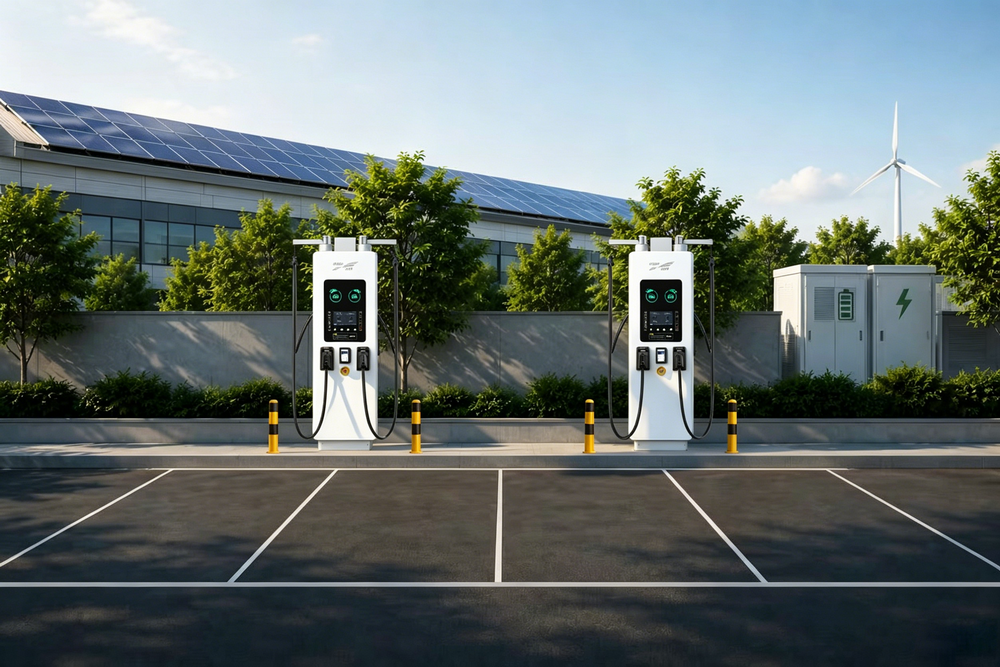
Grid-tied EV charger is often cheaper to deploy in the short term, but PV-ESS-Charging can deliver superior lifetime economics, risk protection, and sustainability for many commercial sites when designed correctly. For an equipment provider like Shenzhen Kehua Hengsheng Technology Co., Ltd., the most profitable path for customers is usually a staged roadmap that starts with optimized grid-tied charging and evolves into PV + storage–integrated smart charging. [alexandria.unisg]
Commercial facility owners today face a strategic choice: invest in pure grid-tied EV chargers or build an integrated PV + storage + EV charging system that turns their site into an energy hub. From my experience working with energy managers and sustainability directors, the right answer depends on load profile, tariffs, and the organization's carbon and resilience targets. [sciencedirect]
For a technology partner like Shenzhen Kehua Hengsheng Technology Co., Ltd. (Kehua), which provides DC charging modules, integrated DC charger, ultra high-power distributed charging system, megawatt charging systems, and PV+ESS solutions, this decision is no longer about hardware alone—it is about system-level economics over 10–20 years. This article walks through a structured comparison and a simplified financial simulation framework to help commercial decision-makers choose with confidence. [charin]
Defining the Two Approaches
What Is Grid-Tied EV chargers for Commercial Facilities?
Grid-tied charging means your EV charger draw all or most of their energy directly from the utility grid, without on-site generation or storage. Typical commercial configurations include: [sciencedirect]
- AC chargers for employee and visitor parking
- DC fast chargers for fleet turnaround and public use
- Basic or semi-smart load management tied to demand limits
The appeal of grid-tied charging is lower upfront CAPEX, simpler permitting, and faster rollout—especially when you deploy Kehua's high-efficiency DC modules and DC fast chargers that already comply with international standards. However, your long-term cost is locked to grid tariffs, demand charges, and future price volatility. [chargedevs]
What Is PV-ESS-Charging?
PV - ESS - Charing adds on-site solar (PV) and battery energy storage (BESS) to the charging system and connects them with coordinated control and monitoring. In a commercial setting, that often means: [scijournals.onlinelibrary.wiley]
- Rooftop or carport PV sized to daytime load
- BESS to shift solar energy into peak tariff windows
- Smart charger that can respond to site-level schedules and constraints
Kehua offers PV-ESS-Charging solutions that integrate solar, storage, and multi-standard DC fast chargers into one coordinated architecture. The result is a hybrid energy system that can reduce grid imports, shave peaks, and provide backup capability for critical loads. [sciencedirect]
Financial Simulation Framework for Commercial Facilities
From an industry practitioner viewpoint, the financial comparison between grid-tied and PV-ESS-Charging should follow a consistent, transparent methodology. Below is a simplified framework you can adapt with your local tariffs and site data. [alexandria.unisg]
Key Financial Inputs to Model
To simulate 10–20 year economics, commercial clients typically need to define:
1. Load profile
- Number of chargers (AC and DC), rated power, and expected utilization
- Peak coincidence with building loads (offices, warehouse, retail, etc.) [sciencedirect]
2. Tariff structure
- Energy charges (flat vs time-of-use)
- Demand charges and seasonal variations
- Incentives or rebates for PV, storage, or EV infrastructure [iea-pvps]
3. System CAPEX and OPEX
- EV chargers and installation
- PV modules, inverters, mounting structures
- BESS cost, replacement cycle, and O&M
- Software and networking for monitoring and control [sciencedirect]
4. Performance and degradation
- PV yield and performance ratio
- Battery round-trip efficiency and degradation
- Charger efficiency and expected uptime [chargedevs]
With these inputs, you can calculate cash flows, payback period, NPV, and IRR for each scenario.
Example 10-Year Financial Comparison (Conceptual)
The table below illustrates a conceptual comparison for a medium-size commercial facility; values are indicative and should be replaced with site-specific data.
| Metric (10-year view) | Grid-Tied Charging Only | PV-ESS-Charging |
|---|---|---|
| Upfront CAPEX | Low–medium ( EV charger+ grid upgrades) | High (EV charger + PV + BESS + control systems) |
| Annual energy cost | High, fully exposed to tariff escalation | Medium–low, due to self-consumption and peak shaving |
| Demand charges | High, driven by coincident fast charging | Reduced via controlled charging and storage discharge |
| Payback period | Shorter initially but limited savings | Longer upfront but stronger lifetime savings |
| Carbon footprint | Depends on grid mix | Significantly lowered via solar generation |
| Resilience | Limited; depends on grid availability | Enhanced; storage can support critical loads and limited islanding |
For many customers I advise, PV-ESS-Charging typically shows higher NPV over 10–20 years under moderate-to-high electricity price scenarios, even when initial CAPEX is 30–70% higher. [sciencedirect]
Real-World Drivers: Tariffs, Carbon, and Fleet Strategy
When Grid-Tied Charging Still Wins
Despite the long-term advantages of integrated systems, grid-tied charging can still be the right first step in several cases:
- Early-stage fleets with uncertain vehicle counts and utilization
- Sites with limited roof or land availability for PV
- Regions where tariffs are low and demand charges minimal
- Projects requiring very rapid deployment with tight budget constraints
In these situations, commercial customers often choose high-efficiency DC fast chargers and modular architectures so they can add PV and BESS later without stranding assets. Kehua's DC charging modules and megawatt chargers are designed to fit this modular upgrade path. [charin]
Why PV-ESS-Charging Is Gaining Momentum
Industry data shows rapid growth in PV + storage deployments, not only in residential but also commercial and industrial segments, driven by declining hardware costs and rising electricity prices. Integrated EV chargers with PV and BESS can: [iea-pvps]
- Cut operational expenditure via self-consumption and demand charge reduction
- Support corporate decarbonization and ESG targets
- Provide grid support services in advanced markets, depending on local regulations and programs [scijournals.onlinelibrary.wiley]
A recent analysis of PV-integrated EV chargers infrastructures found that solar-powered EVs can enhance urban mobility while materially reducing emissions and grid stress. As an equipment provider with over 37 years in power electronics and comprehensive PV+ESS and EV chargers portfolios, Kehua is well positioned to support this transition. [charin]
Technical Architecture Comparison
Grid-Tied Charging Architecture
In a typical grid-tied scenario, the technical stack looks like this:
- Utility grid connection at medium or low voltage
- Distribution panel and transformer upgrades where needed
- AC chargers for long-dwell parking
- DC fast chargers for fleet and high-turnover users
- Optional local controls for basic load limiting
This architecture is simpler to design and commission but offers limited flexibility if tariffs change or if EV adoption accelerates faster than planned. [sciencedirect]
PV + Storage + EV Architecture with Kehua Solutions
An integrated PV + storage + EV setup often includes:
- PV arrays with inverters sized to building + charging loads
- BESS with bidirectional converters
- DC and AC EV charger, possibly including megawatt chargers for heavy-duty fleets
- Site-level control and monitoring that coordinates PV, storage, and EV loads
Kehua's PV-ESS-Charging solutions are specifically designed to integrate these components into a unified system, leveraging high-efficiency DC modules (≥96% full-load efficiency) to minimize conversion losses. Intelligent fan control and wide operating temperature ranges also improve reliability in harsh environments, which is critical for outdoor commercial charging stations. [kehuasz]
Step-by-Step: How to Run Your Own Financial Simulation
From a practitioner's point of view, the most powerful way to decide is to simulate both options using your own data. Here is a practical, expert-level process:
1. Characterize your load
- Gather at least 12 months of building energy data
- Estimate EV chargers demand (kWh/day, peak kW, weekday vs weekend) [sciencedirect]
2. Model a baseline grid-tied charging scenario
- Add chargers to your existing load profile
- Apply your utility's time-of-use and demand charges
- Calculate annual energy and demand costs, then project 10–20 years with price escalation assumptions [iea-pvps]
3. Design PV + storage + EV scenarios
- Size PV using local irradiance and roof/carport area
- Select BESS size (kW/kWh) to target peak shaving and TOU arbitrage
- Apply realistic efficiency and degradation values from vendors or literature [scijournals.onlinelibrary.wiley]
4. Run multiple scenarios
- Vary PV size, battery capacity, and charging control strategies
- Include CAPEX, incentives, O&M, and replacement costs
- Compute NPV, IRR, and payback for each scenario
5. Stress-test assumptions
- Run sensitivity analyses on energy price growth, EV adoption, and policy incentives
- Evaluate what happens if demand charges increase or if you electrify additional loads (e.g., heat pumps, process loads) [iea-pvps]
Kehua's engineering and solution teams can support customers in this process with PV-ESS-charging system design and technical parameters, enabling more accurate simulations. [kehuasz]
Expert Insights: Risk, Resilience, and Future-Proofing
Managing Energy Price and Policy Risk
From an expert risk-management lens, pure grid-tied charging concentrates your exposure in one variable: the grid tariff. PV-ESS-Charging diversifies your energy mix and hedges against: [iea-pvps]
- Future tariff increases or restructuring
- New carbon pricing or emissions-related costs
- Potential grid capacity constraints for high-power charging hubs [alexandria.unisg]
By combining on-site generation, storage, and controllable load, commercial sites effectively gain a degree of energy price insurance over the project lifetime. [scijournals.onlinelibrary.wiley]
Resilience and Business Continuity
For logistics hubs, hospitals, data centers, and large retail complexes, resilience is more than a sustainability talking point—it is a business continuity requirement. PV + storage + EV systems can: [sciencedirect]
- Support emergency operation of key loads during grid outages
- Maintain critical fleet charging for essential services
- Potentially participate in microgrid islanding strategies with the right protection and control schemes [scijournals.onlinelibrary.wiley]
High-reliability hardware and international certifications such as IATF 16949, ISO 14001, ISO 9001, CE, and UL—which Kehua holds—are also important parts of the resilience equation. [charin]
Where Kehua Delivers Additional Value
Hardware Portfolio Aligned with Both Paths
Kehua's portfolio includes:
- DC charging modules and AC chargers for standard grid-tied deployments
- DC fast charging chargers and megawatt charging systems for high-power needs
- PV+ESS products that integrate with EV chargers for PV + storage + EV solutions [charin]
This breadth allows customers to start grid-tied and scale into PV + storage without changing vendors or reworking their entire infrastructure.
Engineering Support for Integrated Systems
With over 37 years of power electronics experience and a large R&D team, Kehua provides not only hardware but also system-level expertise for integrated projects. This includes: [charin]
- System sizing guidance for PV, storage, and charging
- Grid interconnection support aligned with local codes
- Optimization strategies for efficiency, noise, and thermal performance [chargedevs]
For commercial facility owners, this combination of products and engineering support simplifies the move from conceptual financial simulation to a bankable, buildable project.
Practical Takeaways and Recommended Next Steps
From a combined financial and technical perspective, the most effective strategy for many commercial facilities is:
- Start with high-efficiency, modular grid-tied charging to support immediate EV demand
- Incorporate future PV and storage integration into the electrical and civil design
- Use a 10–20 year financial simulation to right-size PV and BESS when budget or incentives align
By partnering with a provider like Kehua, commercial clients can design an upgrade path from simple grid-tied systems to fully integrated PV + storage + EV configurations, maximizing long-term returns while controlling risk. [kehuasz]
Call to Action: Turn Your Site into an Integrated Energy Hub
If you are planning or expanding EV chargers at a commercial facility, your next step should be to quantify the difference between grid-tied charging and PV-ESS-Charging for your specific tariffs and load.
Contact the Kehua team to:
- Request a site-specific financial simulation based on your energy data and fleet plans
- Explore PV-ESS-Charging system designs tailored to your roof space, power capacity, and business goals
- Define a phased roadmap from initial grid-tied deployment to fully integrated, resilient EV chargers infrastructure [charin]
A carefully designed, integrated system can transform your charging infrastructure from a cost center into a strategic energy asset for the next decade and beyond.
FAQ
Q1: Is PV-ESS-Charging always more cost-effective than grid-tied charging?
A: Not always. For small deployments with low utilization and simple tariffs, grid-tied charging can have better short-term economics, especially when CAPEX is tightly constrained. However, as utilization, electricity prices, or demand charges increase, PV + storage + EV configurations often deliver superior lifetime savings and risk protection. [sciencedirect]
Q2: How do demand charges influence the decision?
A: In markets with high demand charges, fast charging can create costly peaks in grid-tied scenarios. PV + storage + EV systems can shave these peaks by discharging batteries and shifting load, significantly improving project economics. [sciencedirect]
Q3: What project sizes benefit most from PV-ESS-Charging?
A: Medium to large commercial sites—such as logistics hubs, retail centers, campuses, and fleets—tend to see the strongest economic and resilience benefits from integrated systems because they have higher and more predictable loads. Smaller sites can still benefit, but the business case should be assessed carefully via site-specific modeling. [scijournals.onlinelibrary.wiley]
Q4: How does Kehua support the design and implementation process?
A: Kehua provides end-to-end EV chargers solutions including DC modules, AC chargers, DC fast chargers, megawatt charging systems, and PV+ESS products, along with engineering support for system design, grid integration, and optimization. This combination helps customers move efficiently from feasibility study to commissioning. [charin]
Q5: Can I start grid-tied and add PV and storage later?
A: Yes. Many commercial customers deploy modular grid-tied systems first and then add PV and storage as EV adoption grows or incentives improve. Kehua's modular chargers and PV+ESS offerings are designed to support this staged approach, reducing the risk of stranded assets. [kehuasz]
References
1. IEA-PVPS. "Trends in Photovoltaic Applications 2024." [Link] [iea-pvps]
2. ScienceDirect. "Current trends and challenges in solar PV-integrated battery energy systems." [Link] [sciencedirect]
3. ScienceDirect. "Design and optimal sizing of PV/grid-integrated EV chargers stations." [Link] [sciencedirect]
4. Wiley Online Library. "Integration of Solar PV Panels in Electric Vehicle Charging." [Link] [scijournals.onlinelibrary.wiley]
5. CharIN. "Shenzhen Kehua Hengsheng Technology Co., Ltd." [Link] [charin]
6. CharIN. "Shenzhen Kehua Unveils High-Efficiency 40kW SiC Charging Module." [Link] [charin]
7. ChargedEVs. "Shenzhen Kehua unveils high-efficiency 40 kW SiC charging module." [Link] [chargedevs]
8. Shenzhen Kehua. "PV-ESS-Charging Solution." [Link] [kehuasz]
9. Alexandria (University of St. Gallen). "Grid Integration of Solar-PV and Electric Vehicles: Analysing the Economic Benefits of Smart Charging for Corporate Prosumers." [Link] [alexandria.unisg]
Hot Tags: PV-ESS-Charging, Manufacturers, Customized, Custom, Suppliers, Buy, Cheap, Quality, Advanced, Durable, in Stock, Made in China, Price, Quotation

