



- Electric Bus Charging Upgraded: Fast & Flexible
- Shenzhen Kehua’s 40 kW High-Efficiency SiC Charging Module Achieves CE, CB, and UL Certifications
- Shenzhen Kehua Unveils High-Reliability All-in-One DC Charger for the ASEAN Market
- Shenzhen Kehua’s Scalable Megawatt Power Unit: Pioneering the Next Era of High-Power Charging for Green Mobility
- Growth Opportunities in the EV Charging Industry Amid the Global Transportation Electrification
- The Future of Fleet Charging: Building Efficient and Reliable Charging Infrastructure
DC Fast Chargers for Destination Charging: Hotels, Resorts, and Malls


Content Menu
● Why DC Fast Charging Is a Game Changer for Destinations
● Destination Charging vs. Highway Fast Charging
● How EV Drivers Actually Use Destination DC Fast Chargers
● Business Value: From "Nice Amenity" to Strategic Asset
● How Many DC Fast Chargers Do You Really Need?
● Technical Basics: Choosing DC Fast Charger Power Levels
● Integrating PV + Energy Storage and V2G for Smarter Destination Charging
>> Why PV + ESS Matters for Destination DC Fast Charging
>> The Role of V2G at Destination Sites
● Step‑by‑Step Roadmap: Deploying DC Fast Chargers at Your Destination
● Expert Design Tips for Hotels, Resorts, and Malls
>> Malls and Retail Destinations
● Why Partner with Shenzhen Kehua Hengsheng Technology Co., Ltd. for Destination DC Fast Charging
● Strong, Targeted Call to Action (CTA)
● FAQs About DC Fast Chargers for Destination Charging
Destination charging has become a core decision factor for electric vehicle (EV) drivers when choosing where to stay, shop, or relax. As an EV charging equipment provider deeply involved in global deployments, I have seen how well-planned DC fast charging transforms hotels, resorts, and malls from "just another stop" into high‑value, repeat‑visit destinations. [solartechonline]
In this guide, I will walk you through why DC fast chargers matter for destination sites, how to choose the right power levels, what real-world operators are doing, and how Shenzhen Kehua Hengsheng Technology Co., Ltd. (Kehua) can support you with DC fast chargers, high‑power distributed and megawatt systems, V2G, and PV+ESS integrated solutions. [en.kehuasz]
Why DC Fast Charging Is a Game Changer for Destinations
For years, destination charging relied primarily on AC chargers (Level 2), which work well for overnight stays but often fall short for short or medium dwell times. As EV adoption accelerates and customers expect more convenience, DC fast charging (DCFC) is becoming the new standard in many commercial properties. [evconnect]
Key reasons DC fast charging matters for destinations:
- Speed that matches real behavior: DCFC can add roughly 150–300+ miles of range per hour, depending on charger power and vehicle, making them ideal for 1–2 hour stays. [powerflex]
- Higher turnover, more customers: Faster charging means more vehicles served per day, increasing both charging revenue and on‑site spending. [bolt]
- Differentiation and brand positioning: Hotels, resorts, and malls that invest in modern DC infrastructure are perceived as premium, sustainable, and future‑ready. [tesla]
- Support for newer, high‑battery‑capacity EVs: As EV batteries grow larger, customers increasingly expect fast, highway‑like charging even in urban destinations. [cyberswitching]
Recent data shows that deployment of DC fast charging ports grew around 30% year‑over‑year in 2025, with operators shifting toward larger, multi‑port stations and higher‑power units (250 kW+). This trend will directly affect expectations from EV drivers visiting your property. [evconnect]
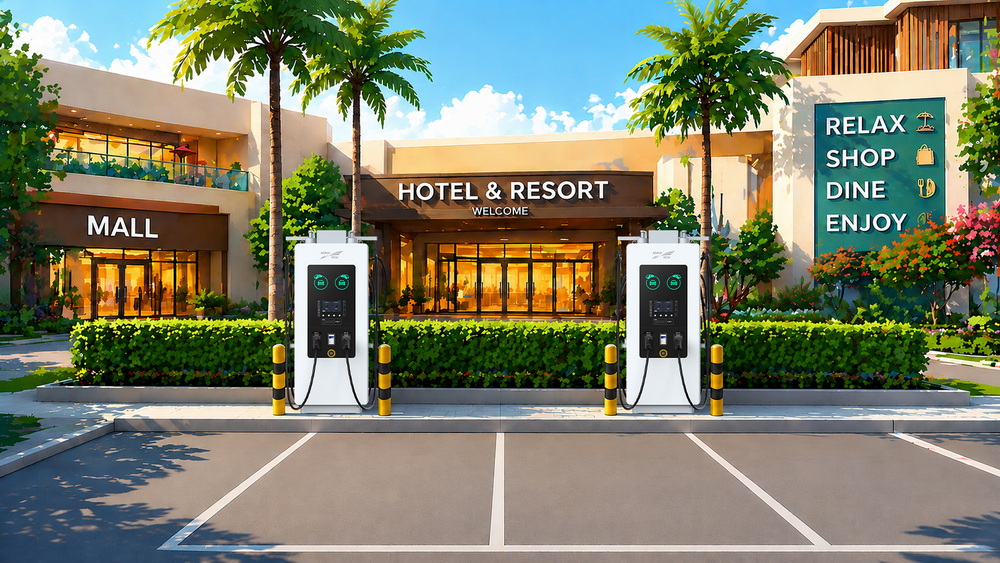
Destination Charging vs. Highway Fast Charging
Although both use DC fast charging, destination sites and highway corridors serve very different use cases. [energy.ca]
| Aspect | Highway DCFC | Destination DCFC (Hotels/Resorts/Malls) |
|---|---|---|
| Main purpose | Minimize trip time | Maximize on‑site experience & spend |
| Typical dwell time | 15–30 minutes | 1–4 hours |
| Optimal power levels | 150–350 kW | 30–150 kW (often 60–120 kW sweet spot) |
| Pricing strategy | Pure energy/time margin | Mixed: amenity, loyalty, upsells |
| Value driver | Long‑distance travel convenience | Customer acquisition & retention |
For destinations, ultra‑high power (e.g., 350 kW) may be less critical than balancing cost, grid capacity, and typical dwell time. Many successful hotels and malls deploy 30–60 kW or 60–120 kW DC fast chargers as a cost‑effective middle ground. [solartechonline]
How EV Drivers Actually Use Destination DC Fast Chargers
Based on user feedback and market observations, EV drivers frequently describe three typical use patterns at destination sites: [bolt]
1. Overnight or full‑day stay (Hotels & Resorts)
- Expect at least one reliable charging option, ideally a mix of AC and DC.
- Many are comfortable with slower charging but appreciate the option of a DC fast charger if they arrive with low battery late at night. [tesla]
2. 2–4 hour leisure visit (Resorts, malls, entertainment complexes)
- Want enough range added during their visit to cover the return trip and daily driving, without thinking about charging again the same day. [solartechonline]
- This is where 60–120 kW DC fast chargers match real‑world behavior very well. [bolt]
3. Short, opportunistic top‑up (Food courts, business meetings, events)
- Drivers plug in for 30–60 minutes while they eat or attend a meeting.
- They highly value clear pricing, easy payment, and reliable uptime over a few extra kW of maximum power. [swtchenergy]
Destination owners that align charger type and power level with these actual user patterns see higher utilization and better reviews.
Business Value: From "Nice Amenity" to Strategic Asset
From my experience supporting commercial projects, DC fast chargers quickly move from cost center to strategic asset when they are planned with clear business goals.
Revenue and ROI Drivers
- Direct charging revenue: Pay‑per‑kWh or time‑based tariffs can generate a new income stream, especially at high‑footfall malls. [evconnect]
- Increased occupancy or visit frequency: EV drivers are more likely to book a hotel or visit a mall that guarantees convenient charging. [stayncharge]
- Higher on‑site spend: While charging, customers stay longer in your restaurant, spa, or retail outlets, increasing average ticket size. [evb]
- Brand value & ESG: Visible DC fast charging integrated with renewables and energy storage signals genuine commitment to sustainability and supports ESG reporting. [en.kehuasz]
A 30–60 kW charger in a commercial destination can often deliver an 80% charge in under an hour, offering a good balance between cost and business impact. [solartechonline]
How Many DC Fast Chargers Do You Really Need?
There is no single answer, but real projects and industry guidance suggest practical starting points: [powerflex]
- Boutique or business hotel (50–150 rooms)
- Start with 1 DC fast charger (30–60 kW) + 2–4 AC chargers.
- Position DC as a premium or priority service, AC as standard overnight charging. [bolt]
- Resort or large hotel (150+ rooms, leisure focus)
- 2–4 DC fast chargers (60–120 kW), depending on parking capacity and EV guest mix.
- Combine with visible sustainability messaging and optional PV+ESS integration. [kehuasz]
- Regional mall or large shopping center
- At least 2 DC fast chargers, preferably dual‑gun units, so you can serve 4 cars at the same time. [evb]
- Reserve 5–10% of parking for EVs, with clear signage and good lighting. [evb]
Start modestly, monitor utilization, then scale using modular, distributed DC systems—a field where Kehua's high‑power distributed and megawatt charging systems excel. [kehuasz]
Technical Basics: Choosing DC Fast Charger Power Levels
When evaluating DC fast chargers for your property, consider these typical power tiers: [powerflex]
- 30–60 kW DC fast chargers
- Ideal for: Small hotels, business parks, mid‑size malls.
- Pros: Lower grid impact and CAPEX; sufficient for 1–2 hour dwell times.
- Example result: 80% charge in under an hour for many modern EVs. [bolt]
- 60–120 kW DC fast chargers
- Ideal for: Busy malls, large hotels, resorts, mixed‑use developments.
- Pros: Good balance between speed, cost, and infrastructure requirements.
- Supports higher turnover without requiring ultra‑high‑power hardware. [evconnect]
- 150 kW+ and megawatt systems
- Ideal for: EV fleets, heavy‑duty vehicles, highway‑adjacent resorts or logistics‑integrated malls.
- Pros: Future‑proof, supports large battery packs and commercial vehicles.
- Often combined with on‑site energy storage and smart energy management to avoid grid peaks. [cyberswitching]
Kehua's portfolio covers DC charging modules, DC fast chargers, high‑power distributed systems, and megawatt charging systems, which lets you build a scalable architecture that grows with your EV traffic. [en.kehuasz]
Integrating PV + Energy Storage and V2G for Smarter Destination Charging
One of the most powerful trends in destination charging is combining EV charging with on‑site solar and energy storage, and increasingly with V2G (vehicle‑to‑grid) capabilities. [cyberswitching]
Why PV + ESS Matters for Destination DC Fast Charging
- Lower energy costs: Use PV generation to supply a portion of charging demand, reducing dependence on grid electricity and volatile tariffs. [en.kehuasz]
- Peak shaving and demand management: Energy storage smooths peaks from DC fast charging sessions, helping avoid expensive demand charges and grid upgrades. [cyberswitching]
- Resilience and backup power: During grid instability or outages, PV+ESS systems can keep critical chargers running, especially important for resorts and premium hotels. [en.kehuasz]
Kehua offers integrated PV + energy storage (PV‑ESS) EV charging solutions, enabling site owners to design charging infrastructure as part of a broader energy strategy, not just a standalone load. [kehuasz]
The Role of V2G at Destination Sites
V2G technology allows EVs to send power back to the grid or local building loads, rather than only drawing power. At destination sites, this opens up compelling use cases: [cyberswitching]
- Smart peak management: Use EVs as temporary distributed storage during local peak demand. [cyberswitching]
- Dynamic energy markets: Participate in demand response or local energy markets where regulations allow. [cyberswitching]
- Enhanced sustainability narratives: Position your hotel or mall as part of a two‑way, intelligent energy ecosystem, not just a passive consumer. [en.kehuasz]
With V2G bidirectional technology in its portfolio, Kehua can support forward‑looking destinations that want to pilot or scale these advanced use cases. [kehuasz]
Step‑by‑Step Roadmap: Deploying DC Fast Chargers at Your Destination
From the perspective of an operator who has seen projects succeed (and occasionally fail), here is a practical implementation roadmap grounded in industry best practices. [swtchenergy]
1. Clarify your business objectives
- Are you aiming for higher room bookings, more mall footfall, premium brand positioning, or new revenue?
- Define KPIs: utilization rate, revenue per port, impact on bookings or dwell time.
2. Assess your site and electrical capacity
- Conduct a professional site survey with an experienced EV charging installer. [swtchenergy]
- Evaluate existing grid capacity, cable routing, parking layout, and expansion options.
3. Select charger types and power levels
- Decide on the mix of AC chargers (for long stays) and DC fast chargers (for shorter visits). [powerflex]
- For most hotels and malls, start with 30–120 kW DC fast chargers linked to modular DC power modules. [bolt]
4. Design user‑friendly parking and wayfinding
- Reserve dedicated EV bays close to entrances, with clear signage and ground markings. [evb]
- Ensure good lighting, CCTV coverage, and safe cable management to enhance perceived safety. [evb]
5. Integrate software, payment, and roaming
- Offer multiple payment options: RFID, app, credit card. [blinkcharging]
- Consider partnering with roaming networks to make your chargers visible in hotel EV search platforms and navigation apps. [cars.usnews]
6. Explore PV, ESS, and V2G integration
- Size PV and storage to match your expected charging demand patterns. [en.kehuasz]
- Use an integrated energy management platform to schedule charging, discharge storage, and participate in grid programs where available. [cyberswitching]
7. Plan maintenance and uptime
- Work with a solutions partner that can provide remote monitoring, predictive maintenance, and fast on‑site service. [blinkcharging]
- High uptime is crucial—EV drivers quickly leave negative reviews when chargers are offline.
8. Promote your EV‑ready destination
- Highlight charging in your website, booking engines, marketing campaigns, and loyalty programs. [stayncharge]
- Use "EV‑friendly" badges and dedicated landing pages to capture EV driver interest.
Expert Design Tips for Hotels, Resorts, and Malls
Drawing from industry reports, real‑world projects, and direct feedback from EV drivers, here are expert recommendations for each destination type. [solartechonline]
Hotels and Resorts
- Mix AC and DC: Offer AC for overnight stays and DC for late arrivals or short‑stay guests. [powerflex]
- Integrate with guest journey: Let guests reserve charging when they book and see charger status in your app or web portal. [stayncharge]
- Bundle pricing: Consider complimentary or discounted charging for premium rooms or loyalty tiers, while walk‑ins pay standard rates. [solartechonline]
- Sustainability storytelling: Showcase PV+ESS‑backed charging in your lobby displays, website, and ESG reports. [en.kehuasz]
Malls and Retail Destinations
- Put chargers where people naturally park, not hidden behind service areas. [evb]
- Use time‑limited EV bays to discourage ICE parking and charger blocking. [evb]
- Combine charging with in‑mall promotions (e.g., free charging for purchases above a certain amount). [bolt]
- Plan for scale using high‑power distributed DC systems so you can incrementally add more plugs without full redesign. [kehuasz]
Why Partner with Shenzhen Kehua Hengsheng Technology Co., Ltd. for Destination DC Fast Charging
Kehua is not just a hardware supplier; it is a full‑stack EV charging and energy solutions provider with over 37 years of expertise in power electronics. [kehuasz]
Key strengths relevant to hotels, resorts, and malls:
- Comprehensive product portfolio
- DC charging modules, AC chargers, DC fast chargers.
- High‑power distributed and megawatt charging systems for large sites and fleet‑integrated destinations. [kehuasz]
- Integrated PV + ESS + charging solutions
- End‑to‑end systems that combine solar, energy storage, and EV charging for lower energy costs and higher resilience. [kehuasz]
- V2G‑ready, future‑proof technology
- V2G bidirectional solutions for next‑generation energy ecosystems at premium destinations. [en.kehuasz]
- Global project experience
- Backed by a large R&D team and international deployments, Kehua can support complex, multi‑site destination charging projects. [kehuasz]
For destination operators, this means you can design, deploy, and scale DC fast charging infrastructure with a single partner that understands both EV charging and advanced energy systems.
Strong, Targeted Call to Action (CTA)
> Ready to transform your hotel, resort, or mall into an EV‑ready destination?
> Contact Shenzhen Kehua Hengsheng Technology Co., Ltd. today to discuss a customized DC fast charging solution—integrated with PV, energy storage, and V2G—designed around your property, your guests, and your business goals.
FAQs About DC Fast Chargers for Destination Charging
1. Why should I install DC fast chargers instead of only AC chargers at my hotel or mall?
DC fast chargers support shorter dwell times and offer significantly faster charging than AC, which better matches how many guests and shoppers actually use your property. AC is ideal for overnight or long‑stay parking, but DC fast charging is now a key differentiator for convenience‑focused EV drivers. [powerflex]
2. How do I choose the right DC fast charger power level for my destination?
Most hotels and malls find that 30–120 kW DC fast chargers provide the best balance between speed, cost, and electrical infrastructure requirements. Higher power (150 kW+) may be needed for heavy‑duty vehicles or very high‑traffic environments, often combined with energy storage. [evconnect]
3. Can I integrate solar and battery storage with my EV charging infrastructure?
Yes. Many destinations now combine PV and energy storage with DC fast chargers to reduce energy costs, manage peak loads, and improve resilience. Kehua provides integrated PV+ESS charging solutions specifically designed for this purpose. [cyberswitching]
4. Is V2G technology relevant for hotels and malls today?
V2G is emerging but increasingly relevant where regulations and market structures allow it. It lets EVs feed power back to the building or grid, helping with peak shaving and supporting advanced energy‑as‑a‑service business models for forward‑looking destinations. [en.kehuasz]
5. How do I make sure my chargers are easy for guests to find and use?
List your chargers on major EV apps and hotel EV search platforms, use clear on‑site signage, and integrate real‑time availability into your website or booking flow. Provide simple payment options and clear instructions at each charger to reduce friction for first‑time users. [cars.usnews]
References
1. Bolt.Earth – Choosing the Right DC Fast Charger for Hotels, Malls and Office Spaces
<https://bolt.earth/blog/choosing-the-right-dc-fast-charger-for-hotels-malls-and-office-spaces> [bolt]
2. Stay‑N‑Charge – *Find Hotels with EV Charging Stations*
<https://www.stayncharge.com> [stayncharge]
3. Solartech – *Hotels With EV Charging: Complete 2025 Guide To Electric Vehicle Travel*
<https://solartechonline.com/blog/hotels-with-ev-charging-complete-guide/> [solartechonline]
4. EVB – *Best Places to Install Commercial EV Chargers*
<https://www.evb.com/install-commercial-ev-chargers/> [evb]
5. Tesla – *Destination Charging*
<https://www.tesla.com/destination-charging> [tesla]
6. EV Connect – *2025 EV Charging Industry Report*
<https://www.evconnect.com/blog/2025-ev-charging-industry-report/> [evconnect]
7. PowerFlex – *How to Install Commercial EV Charging Stations for Your Business*
<https://www.powerflex.com/blog/how-to-install-commercial-ev-charging-stations-for-your-business> [powerflex]
8. Shenzhen Kehua – *Reliable EV Charging Equipment Provider – Company Profile*
<https://en.kehuasz.com/global/company-profile.html> [en.kehuasz]
9. Shenzhen Kehua – *China EV Charger, EV Charging Module & PV‑ESS Charging Solutions*
<https://www.kehuasz.com> [kehuasz]
10. CyberSwitching – *The Future of Charging Infrastructure: Trends 2025–2030*
<https://cyberswitching.com/the-future-of-charging-infrastructure-trends-2025-2030/> [cyberswitching]
11. SWTCH – *EV Charging for Commercial and Business Properties*
<https://swtchenergy.com/blog/ev-insights/ev-charging-for-commercial-and-business-properties/> [swtchenergy]
12. U.S. Department of Energy – *Electric Vehicle Charging Infrastructure Trends*
<https://afdc.energy.gov/fuels/electricity-infrastructure-trends> [afdc.energy]
13. California Energy Commission – *Best Practices for Installation of Direct Current Fast Charging Corridors*
<https://www.energy.ca.gov/sites/default/files/2022-01/CEC-600-2022-003.pdf> [energy.ca]
Hot Tags: DC Fast Chargers, Manufacturers, Customized, Custom, Suppliers, Buy, Cheap, Quality, Advanced, Durable, in Stock, Free Sample, Made in China, Price, Quotation

